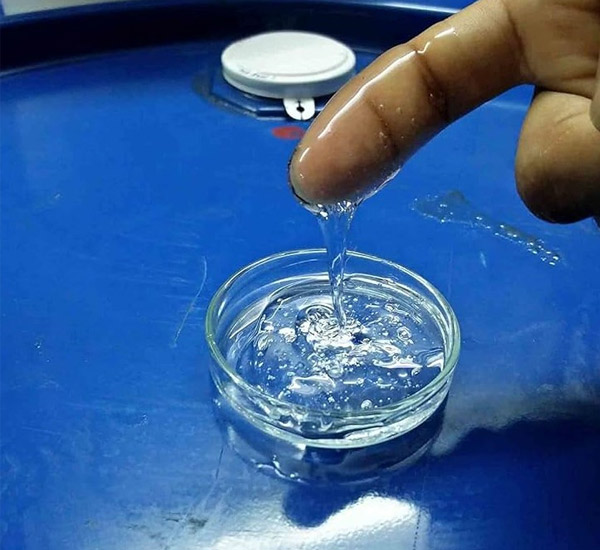
The most common silicone oils are linear polysiloxane compounds, where the silicon atoms are positioned in spiral chains and slide easily over each other. Silicone oils offer great thermal stability at extreme temperatures and provide flexible and fluid forms. Polydimethylsiloxane is the predominant silicone polymer produced, but other organic groups (such as phenyl, vinyl, epoxy, or amino) can be added to the siloxane polymer to provide special properties or reactivity in some cases. The viscosity of silicone oils can vary greatly, ranging from 0,65 cSt to 2,000,000 cSt, and the viscosity remains stable across a wide temperature range. Silicone polymers also exhibit remarkable thermal stability (up to 250°C) compared to some organic polymers, due to the unique characteristics of the chemical bonds between silicon and oxygen in the polymer chain. Silicones spread easily on surfaces due to their very low surface tension and have high compressibility compared to different hydrocarbon and mineral oils. Siloxane polymers also have well dielectric properties and resistance to shear stress, natural aging, oxidation, and hydrolysis.
IN WHICH AREAS IS SILICONE OIL USED?
In case of mechanical components in plastic or rubber
In industrial plants as a diathermic fluid
In paper printing as a release agent
As a hydraulic fluid with high viscothermal stability
As an antifoam additive
In soft closing mechanisms as a fluid for friction control
As a polishing and protective agent
In high voltage transformers as a dielectric fluid